Why Hard Work Alone Isn’t Getting You Promoted (And 4 Things to Do Instead)
Quick answer: Why hard work alone isn’t getting you promoted is because promotions go to the person leaders can see, understand and defend, not the person who delivers the most. To change, translate your work into business outcomes, put it in front of the people who decide, and make yourself ready to be replaced.
In this post
- Why hard work alone isn’t getting you promoted
- Which career phase you’re really in
- 5 signs your hard work is invisible
- 4 moves that change how leaders see you
- FAQ
Why hard work alone isnt getting you promoted is a question many ambitious professionals ask after years of long hours, weekend tasks, and constant effort without recognition. If you find yourself wondering why effort isn’t paying off, the answer lies in visibility, positioning, and how decision-makers view value.
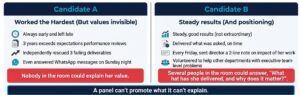
A few years ago, I sat in a closed-door interview panel. Two files were on the table for one senior manager role.
File A. She was always early and left late. Three years in a row, her performance review said the same thing: exceeds expectations. When three deliverables were failing, she rescued all three on her own. She even answered WhatsApp messages on Sunday night.
File B. Steady. Good results, but not extraordinary. She delivered what was asked on time. And every Friday she sent her director a two-line note on what had changed because of her work. She presented one result at the Monday leadership meeting. She volunteered to help another department with a problem the executive team cared about.
In less than twenty minutes, the panel gave the senior manager role to B.
Nobody in that room doubted that A worked hard. The problem was simpler and crueller.
Someone asked, “What has she delivered, and why does it matter?”
About B, several people could answer.
About A, there was a pause. Then: “She’s very hard-working.”
Pay attention now. A panel can’t promote what it can’t explain.
Candidate A didn’t just lose the promotion. She was never really in the running.
So learn this: Kizuri chajiuza works for fresh mandazi at a roadside stall. It doesn’t work in a promotion panel.
Explaining your work is a skill, and nobody taught it to her.
So If you keep asking yourself “why am I not getting promoted?”, this is the answer I watched play out for more than 12 years on the hiring side of the table. It was never your work ethic. It was your positioning.
Why hard work alone isn’t getting you promoted
Hard work doesn’t get you promoted because a promotion is a decision about the future, and hard work is evidence about the past.
A panel is asking one question: is this person ready for the next level, and can we defend choosing them?
If they can’t explain your value quickly, you don’t make the shortlist.
Three things sit behind that.
- Decision-makers see summaries, not your effort. They rely on a few lines in a file and on what people in the room say about you. Your long hours are invisible to them.
- Reliable performers are hard to move. Organizations are often reluctant to move high performers out of roles where they already deliver excellent results. If you make the team run, your manager has a reason to keep you exactly where you are.
- Doing the work and being understood for the work are different skills. Nobody teaches the second one.
The hardest working person in the room rarely gets promoted. The person who understands executive positioning gets chosen every single time.
Which career phase are you really in?
In The Career Growth Blueprint, I map every career in five phases: Foundation Builder, Proven Contributor, Strategic Leader, Innovation Driver and Legacy Creator. Most “hardworking but stuck” stories sit at the line between Phase 2 and Phase 3.
| Phase 2: The Proven Contributor | Phase 3: The Strategic Leader | |
|---|---|---|
| Primary focus | Deepening expertise, expanding influence, clarifying direction | Leading teams, influencing strategy, developing others |
| How success is measured | Recognized expertise and cross-functional impact | Team and department results, and a pipeline of future leaders |
| How you’re seen | A reliable expert who delivers | Someone who shapes outcomes through other people |
| The sign you’ve arrived | You’re driving outcomes beyond your formal job description | Your success is measured by outcomes you influence, not just your own output |
Phase 2 is where I see the most talent stall. In the book I estimate that around 60% of careers plateau here, because the very competence that earned you trust becomes a comfortable place to stay.
These phases aren’t strictly linear. You can cycle back when you change industries or roles, and you can sit in more than one at once.
5 signs your hard work is invisible and why hard work alone isn’t getting you promoted
If you are wondering why hard work alone isn’t getting you promoted, check if you recognize these 5 signs of invisible effort:
- Your updates are task lists. You report what you did, not what changed because you did it.
- Only your direct manager can describe your impact. Ask yourself whether a director in another department could explain your value in about ten seconds.
- You say yes to everything. I call this the Yes Person Syndrome: constant requests accepted, burnout rising, and no strategic focus to show for it.
- You’re so good in your role that moving you creates a gap. Your excellence has become the reason you stay put.
- You get praise, not scope. People say “great job,” but you’re not invited into strategic discussions or handed bigger problems.
Two or more of these? You’re likely a Proven Contributor who is ready for Phase 3 but isn’t being seen that way yet.
4 moves that change how leaders see you and fix why hard work alone isn’t getting you promoted
The most frustrating part of a career stall is realizing that effort does not equal advancement. If you are struggling with why hard work alone isnt getting you promoted, the solution is strategic visibility. Use these four exact moves to rewrite your professional narrative:
1. Translate tasks into business outcomes
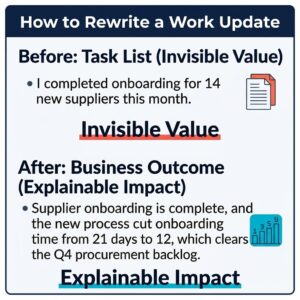
Leaders don’t promote task lists. They promote people who move numbers they care about. Take your next update and rewrite it so the result comes first.
- Before: “I completed onboarding for 14 new suppliers this month.”
- After: “Supplier onboarding is complete, and the new process cut onboarding time from 21 days to 12, which clears the Q4 procurement backlog.”
The numbers above are illustrative. Use your own.
2. Make your work visible without sounding self-promotional
Visibility doesn’t mean bragging. It means the right people know what you’ve done and why it matters. Here is the script I teach in The Career Growth Blueprint:
“I wanted to share a quick update on the client analysis project. I’ve completed the initial research phase and identified three key trends that might impact our Q4 sales. Would it be helpful if I prepared a brief presentation for the team meeting?”
Notice what it does. You’re not saying “I’m great, recognize me.” You’re saying here’s what I’ve done, here’s the business impact, and here’s how I can help the team move forward.
3. Curate your projects instead of collecting them
Stop saying yes to every opportunity. Choose two or three projects that position you for the next level, and split your extra effort like this:
- 70% on high-visibility, high-impact projects that matter to senior leadership
- 20% on building skills your next role will need
- 10% on “moonshot” projects that could open a breakthrough opportunity
4. Make yourself promotable by making yourself replaceable
This feels backwards, and it’s the move most strong performers skip. If your absence would create a gap, your manager has every reason not to promote you.
- Document your key processes.
- Train two or more people who could handle your responsibilities.
- Build systems that reduce dependency on you personally.
- Identify and develop your successor.
Frequently asked questions
Q. Why hard work alone isn’t getting you promoted?
Because promotion decisions rely on what leaders can see and explain about you, not on how much you deliver. If decision-makers can’t describe your value in a sentence, you’re easy to overlook, however hard you work. Visibility and positioning close that gap.
Is working harder ever the answer?
Strong results are the entry ticket. Without them, nothing else in this post works. But past a certain point, more output adds little. More visibility and influence add a lot.
Should I just ask for the promotion?
Asking works best once your case is easy to understand. Translate your work into business outcomes first, then ask with evidence rather than effort.
How long does it take to change how leaders see me?
It depends on your industry and how often promotion decisions are made. In Jennifer’s case it took 12 months. The principle holds in any timeframe: start now, because visibility compounds.
Get your free 30-60-90 Day Quick Start Guide
Knowing why you’re stuck is step one. Step two is a plan. The free 30-60-90 Day Quick Start Guide turns your next 90 days into specific weekly actions:
- Days 1–30: Assess and plan. Find your current phase, collect honest feedback from the people around you, set your career goals and write your strategy.
- Days 31–60: Build. Develop your priority skills, volunteer for high-visibility projects and grow your internal and external network.
- Days 61–90: Execute and review. Take on stretch assignments, share your expertise, check your progress and plan the next quarter.
Download the free 30-60-90 Day Quick Start Guide
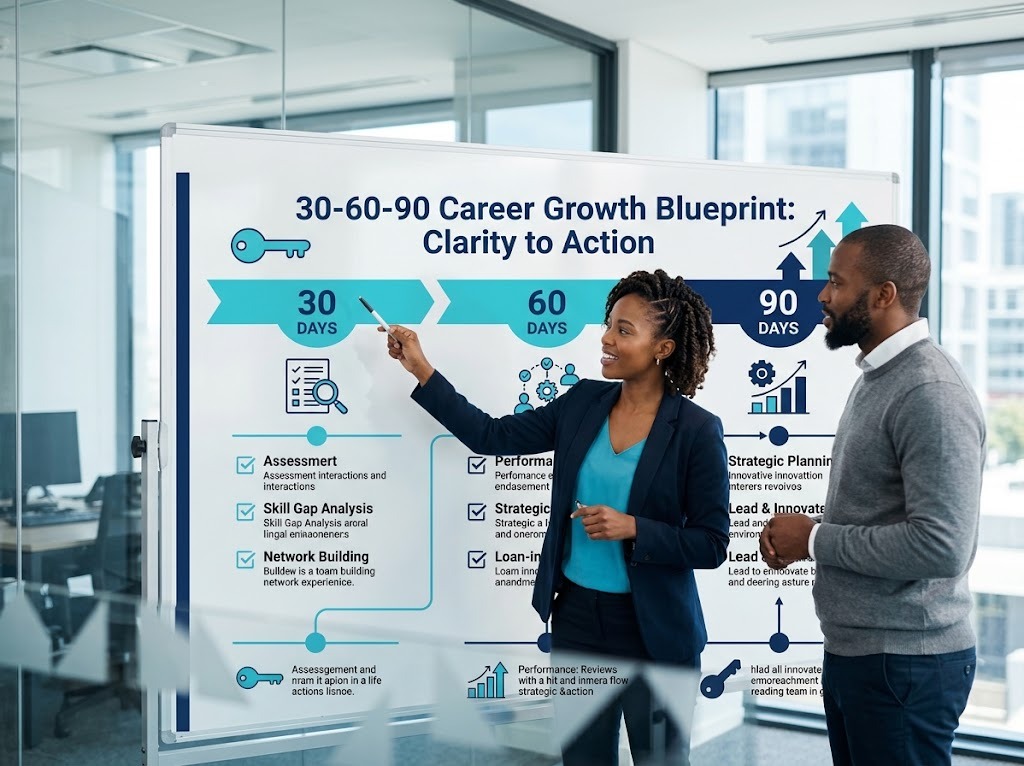
The guide is one of three tools inside The Career Growth Blueprint. The book also includes the Career Phase Assessment, which shows which of the five phases you’re in, and the Transition Readiness Assessment, which shows whether you’re ready to move up.
Get The Career Growth Blueprint Now
Available as a Kindle eBook, paperback and hardcover.
Reflection: If your director had to describe your value in one sentence tomorrow, what would they say? And would you be happy with it?

About the author. Lilian Wanyoike, CHRP, is an executive career strategist and the author of The Career Growth Blueprint. She has spent more than 12 years in global HR leadership across Africa and Europe, including as HR Lead at Trócaire and Mercy Corps, sitting on the panels that decide who gets promoted. She works 1-on-1 with ambitious professionals on executive positioning. Work with Lilian