The Mid-Career Plateau or Burnout: 3 Simple Steps to Reset
Quick answer: A mid-career plateau and burnout feel almost the same, but they are different problems. With burnout, you are drained. With a mid-career plateau, you are bored and stuck. Treat one like the other and you will either quit a job you could have fixed, or rest for a month and return to the same ceiling. This post shows you how to tell which one you have, and what to do in the next 90 days.
In this post
- How to tell burnout from a mid-career plateau
- Why capable professionals stop advancing
- 3 steps to reset your career without a rushed move
- Whether to rework your role or plan a move
- FAQ
Let me describe someone you may know.
It is Sunday, around 7 pm. She is a manager with nine years in the same industry. She has just finished ironing her shirt for Monday. And a heaviness settles on her chest.
It is not that she hates her job. She is good at it. Her last appraisal said “exceeds expectations” again. Her boss says “you’re doing great” at the end of every review.
But when she thinks about next year, she sees this year. When she thinks about five years from now, she sees this year again.
She asks herself: Am I tired? Or am I stuck?
She is a composite of many professionals I have met. Her details are changed. Her question is not.
If that Sunday evening feeling sounds familiar, you may be facing a mid-career plateau. Or you may be burned out. The answer decides what you should do next.
How can you tell burnout from a mid-career plateau?
Here is the simplest test I know. Ask yourself one question: “If I had two weeks of real rest, would I want my job back the way it is?”
- If yes, you are probably tired. That is burnout, or close to it.
- If you would return rested but still feel flat and stuck, that is a mid-career plateau.
The World Health Organization describes burnout as an occupational phenomenon linked to chronic workplace stress, marked by exhaustion, mental distance from your job and reduced effectiveness. A plateau is different. Your energy can be fine. You just have nowhere to put it.
|
Burnout |
Mid-career plateau |
|
|---|---|---|
|
What you feel |
Exhausted. Cynical. Detached from work that used to matter. |
Restless. Under-challenged. Flat. |
|
Your energy |
Low, even after a weekend. |
Fine. You have nowhere to use it. |
|
Your workload |
Too much, with too little support. |
Steady, familiar, repetitive. |
|
What you hear |
“Can you also take this?” |
“You’re doing great.” (and nothing changes) |
|
What helps |
Less pressure, more recovery, clearer boundaries. |
More scope, more visibility, a clear path. |
|
What makes it worse |
Pushing harder. |
Waiting patiently. |
Many people have both. A heavy workload with no growth path is the most common mix I see. If that is you, fix the pressure first. You cannot plan a promotion when you are running on empty.
Why does a mid-career plateau happen to capable professionals?
In The Career Growth Blueprint, I describe five career phases. A mid-career plateau almost always sits in Phase 2, the Proven Contributor.
A Proven Contributor has earned trust. You deliver. People rely on you. And that is exactly the trap.
The competence that got you here becomes a comfortable place to stay. Your manager does not want to lose someone who makes the team run. You do not want to risk a mistake in a role you have mastered. So nothing moves.
In the book, I estimate that around 60% of careers plateau at this phase. That is my own estimate from years of watching promotion decisions, not a published study. But in any company, you can probably name three colleagues who fit.
Three things usually keep people on a mid-career plateau:
- Mastery turns into repetition. You have solved the same problem so many times that it no longer stretches you.
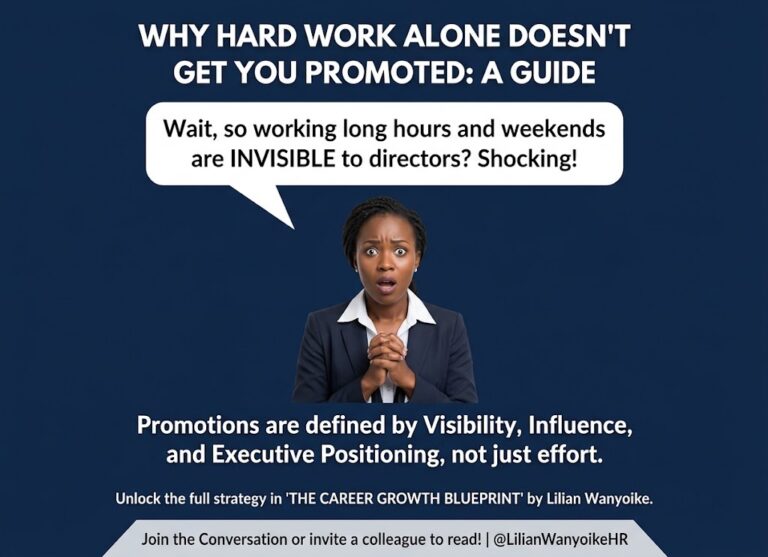
- Nobody outside your team knows what you do. Your manager can describe your work. Nobody else can. I wrote about this in why hard work alone isn’t getting you promoted.
- More responsibility arrives without more support. You carry bigger loads with the same title and the same pay. That slides straight into burnout.
3 steps to get off a mid-career plateau without a rushed move
When people feel stuck, the instinct is to resign. Sometimes that is right. More often it means taking the same mid-career plateau to a new office. Here is a calmer approach.
Step 1: Name what you actually have
Answer these five questions honestly. Write the answers down.
- Am I drained even after rest? (burnout)
- Am I bored even when I am rested? (plateau)
- Does anyone outside my team know what I deliver?
- When did I last learn something that scared me a little?
- If my manager had to describe my next step in one sentence, could they?
Mostly yes to 1? Start with recovery. Mostly yes to 2 and 3, and no to 4 and 5? You are on a mid-career plateau. Both? Fix the workload first, then the path.
Step 2: Choose one 90-day goal
Not five goals. One. And split it into three stages:
- Days 1–30: Reduce avoidable pressure, and collect honest feedback from two or three people outside your team.
- Days 31–60: Test one growth opportunity. Volunteer for a project the senior team cares about, or take on a stretch task.
- Days 61–90: Review what changed, and decide whether to keep going, adjust or plan a move.
This is the structure of the free 30-60-90 Day Quick Start Guide, with weekly actions for each stage.
Step 3: Make your growth visible
Doing a stretch project quietly will not end a mid-career plateau. People need to see it. Here is a way to ask without sounding desperate:
“I want to grow in this company, and I’d like to understand what the next level looks like. Could we spend twenty minutes this month on what I would need to show to get there?”
Then listen. If your manager can name a clear path, stay and follow it. If you ask twice over six months and nothing concrete comes back, you have your answer, and it is a calmer, better-informed reason to look elsewhere.
Should you rework your role or leave your mid-career plateau behind?
Use this rule:
- Stay and rework your role if there is a credible path, your manager is willing to talk about it, and the problem is mostly workload or visibility.
- Plan a move if you have asked clearly more than once, nothing changes, and you have already tried to take on more scope.
Either way, test your readiness first. The Transition Readiness Assessment in the book scores your motivation and capabilities, and the market and company around you. Then you move because you chose to, not because you were tired on a Sunday evening. If your plateau comes from staying in one role too long, my guide on how to fix a stalled career goes deeper.
Frequently asked questions about a mid-career plateau
How do I know if I’m burned out or on a mid-career plateau?
Imagine two weeks of real rest. If you would return energized but still flat, it is a mid-career plateau. If you would still be drained, it is burnout.
How long should I wait before calling it a plateau?
Look at the pattern over several weeks, not one bad day. If the flat feeling lasts a few months with no change in scope, feedback or responsibility, treat it as a plateau.
Can I fix a mid-career plateau without quitting?
Often, yes. Ask for a direct growth conversation, take on one visible stretch project and make your impact easier to see. Many plateaus are about visibility, not about the company.
What if I have burnout and a plateau at the same time?
Fix the workload first. You cannot build a promotion case while exhausted. Then test whether a real growth path exists.
Do I need to change careers to get unstuck?
Usually not. Most people need a clearer path, more visibility or a different role in the same field before they need an entirely new career.
Your next 90 days after a mid-career plateau
The difference between a plateau and a pause is a plan. The free 30-60-90 Day Quick Start Guide gives you one, with weekly actions for each stage.
Download the free 30-60-90 Day Quick Start Guide
[IMAGE 2: Cover mockup of the guide beside the button.]
To find out which of the five phases you are in, the Career Phase Assessment inside The Career Growth Blueprint will show you in about 30 minutes. If you would rather work through it with me, you can book a strategy session here.
Reflection: What would you change about next Monday if you were no longer afraid of Sunday evening?